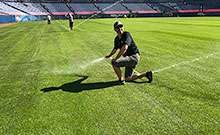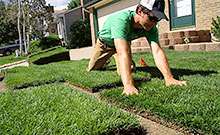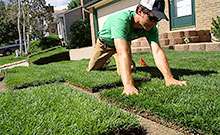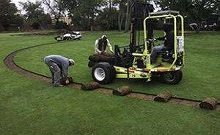
A big-roll golf tee renovation in Littleton, CO, is not simply a sod order. A teeing ground is a carefully managed playing surface where grade, drainage, rootzone, irrigation, traffic, and the course calendar all have to work together.
The most reliable projects define those conditions before equipment and sod arrive. The planning process should confirm the reason for the renovation, the proposed grade, the turf specification, the delivery route, the irrigation plan, and the closure window.
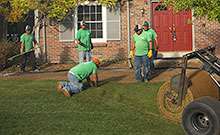
Green Valley Turf provides big-roll sod installation for golf applications and lists tees, driving-range tees, greens, bunkers, fairways, and sports fields among its applications. The company says its own staff installs its sod and uses full-flotation tires intended to reduce surface impact during installation. Actual access, equipment requirements, turf availability, and scheduling should still be confirmed for the specific project.
Begin with the playing or maintenance problem rather than the roll format. A tee may need renovation because it is:
The solution depends on the cause. A tee with minor surface undulations may require a different treatment than one with major settlement, drainage problems, poor soil, or an incorrect profile.
The USGA’s tee-leveling guidance recommends reviewing tee size, alignment, drainage, soil conditions, and shade before work begins. If the project includes enlarging or realigning a tee, changing the profile, or correcting a significant agronomic issue, involve the course’s architect, agronomist, superintendent, or other design professional early.
A useful pre-bid package should include:
Photos should show the tee perimeter, equipment approach, staging area, cart paths, slopes, bridges, overhead obstacles, and nearby sensitive turf. A square-footage estimate alone does not describe the logistical difficulty of a golf course sod installation.
Big rolls require a route that protects both the existing course and the renovated tee. Before scheduling delivery, identify:
Confirm whether delivery trucks can reach the staging point and whether smaller equipment will be needed to move sod from that location. The course should also identify who will direct equipment and how golfers, carts, and maintenance traffic will be routed around the work.
Big-roll equipment may reduce the number of passes or seams required, but low-impact equipment is not a substitute for route planning. Soil moisture, slope, surface condition, and the condition of turf outside the work area all affect the risk of rutting or damage.
The installation sequence should be reviewed alongside the access plan. If the route crosses maintained turf, establish temporary protection and avoid moving equipment during conditions that could cause unacceptable compaction.
Irrigation should be part of the renovation plan from the beginning. Before sod removal or grading, mark:
The USGA recommends clearly marking irrigation heads and temporarily removing and capping heads when necessary. After grading, heads should be reinstalled and adjusted to the finished surface.
This is more than a damage-prevention step. A head that is left at the old grade may sit too high, too low, or at the wrong angle after renovation. Completing irrigation adjustments before establishment helps the superintendent manage the new tee consistently.
A clear scope should distinguish removal from cultivation, material placement, grading, and sod installation.
Green Valley Turf describes specialized removal equipment for larger turf projects and cultivation equipment that can blend rootzone soils. Those capabilities may be useful when the project specification calls for them, but deep cultivation is not automatically appropriate for every tee.
The USGA cautions against rototilling or deeply cultivating before grading because excessive disturbance can increase the time required for soil to settle and firm. If compacted clay must be cultivated, the guidance recommends light cultivation rather than unnecessary deep disturbance.
Grade verification should be a defined project milestone:
The USGA identifies a 1 percent slope, ideally away from golfer traffic and toward the rough, as a reference for surface drainage on a leveled tee. That is a technical guideline, not a substitute for the project drawings, drainage design, site conditions, or approval from the course’s technical team.
If imported material is needed, specify its compatibility with the existing profile. Mixing unlike materials can create changes in drainage, moisture retention, stability, or root development. The goal is a consistent growing medium that can be graded, firmed, irrigated, and maintained as one surface.
Big rolls can provide a broad surface with fewer seams and edges than smaller slabs. They are not automatically the right choice for every tee, however. The decision should account for:
Green Valley Turf currently lists golf bentgrass options including Pure Distinction, T-1, 777, and 007XL grown in 100% USGA-specification sand. The company lists bentgrass in slab and big-roll formats, while its harvest-options page describes big-roll widths and lengths that can vary by product and project.
Those formats should be confirmed against the approved turf specification. A sand-based tee, for example, should be evaluated as a complete system: existing rootzone, proposed material, sod rootzone, irrigation, drainage, and maintenance plan. Turf should not be selected solely because it is available in a large roll.
Green Valley Turf states that its big-roll service includes sod installation, rolling, fertilizer application, and cleanup. The final scope should identify which party is responsible for finish grading, irrigation adjustment, establishment monitoring, and reopening approval.
A new tee needs an irrigation system that is operating and adjusted to the completed grade. Establishment watering should be based on the turf species, rootzone, weather, slope, and infiltration rate rather than a fixed number of days.
Colorado State University Extension notes that sandy soils hold less plant-available moisture and generally require more frequent irrigation with smaller applications than clay or loam soils. It also warns that water can run off slopes, thatchy surfaces, heavy clay, or compacted soil when applied too quickly.
For a renovated tee, the superintendent and irrigation team should establish:
Green Valley Turf says big-roll sod can handle traffic sooner than some alternatives, but that does not establish a universal reopening date. The course should reopen the area only when the sod has rooted sufficiently and the surface meets its own agronomic and playability standards.
Phasing gives the course control over closures, access, labor, and reopening. Instead of closing every tee at once, a facility may renovate selected tee groups in rotation. The USGA notes that many facilities level tees on a rotating schedule to limit disruption.
For each phase, identify:
The work window should account for the course calendar, expected traffic, turf availability, site conditions, and establishment needs. Avoid publishing a reopening date before the final turf specification, delivery schedule, weather plan, and inspection criteria are confirmed.
Send the tee count, approximate square footage, intended use, turf preference, rootzone information, access photos, drawings, desired work window, closure limits, and bid deadline.
Also note drainage symptoms, irrigation concerns, shade issues, and whether the proposed scope includes removal, cultivation, grading, irrigation adjustments, big-roll sod installation, or cleanup. This information allows the project team to discuss the actual work instead of estimating from area alone.
No. The appropriate method depends on the severity and cause of the unevenness, the condition of the existing turf, the rootzone, drainage, traffic, and the course schedule.
The USGA describes several tee-leveling approaches. Minor undulations on a suitable sand-based tee may be addressed differently from a crowned, settled, poorly drained, or incorrectly constructed tee. A site review should determine whether the project requires complete removal, limited grading, aeration and rolling, or another treatment.
It can be considered when the turf species, sod rootzone, existing tee profile, roll format, and installation method match the approved specification.
Green Valley Turf lists sand-grown bentgrass options and big-roll installation for golf applications. Confirm product availability, harvest format, delivery access, and compatibility with the existing or proposed rootzone before finalizing the order.
Big rolls can cover a broad area with fewer seams and edges than smaller slabs. They may also support an efficient installation sequence when the tee geometry, access route, equipment, and crew are appropriate.
The advantages depend on site conditions. Tight access, irregular perimeters, wet soil, steep slopes, or a specification requiring a particular slab size may affect the decision.
Use a written phase plan. Assign tee groups, closure boundaries, equipment routes, inspection points, irrigation checks, and reopening authority for each phase.
Renovating a limited number of tees at a time can help maintain play and maintenance operations, but the schedule must remain flexible enough to account for weather, delivery timing, grade corrections, and turf establishment.
Confirm the tee’s climate exposure, shade, traffic, mowing requirements, irrigation capacity, rootzone, maintenance program, and intended playing conditions. The turf should also be available in the required harvest format for the planned work window.
A turf consultation should evaluate the entire playing-surface system rather than treating species and roll size as separate decisions.
For a big-roll golf tee renovation in Littleton, bring the access plan, tee measurements, grade information, rootzone details, turf specification, irrigation status, drawings, and desired downtime to the first conversation.
Contact Green Valley Turf to discuss a 2027 pre-bid consultation, current turf availability, installation logistics, and the next steps for your project.
Green Valley Turf — Littleton Location
13159 US-85
Littleton, CO 80125
(303) 798-6764